


Visible in ChatGPT and other AI language models? How does that work?
AI is fundamentally changing where and how companies will be visible in the future. If decision-makers don’t act now, their brands could soon face digital invisibility.
This article shows you why it’s no longer enough to just be found on Google—and explains exactly how to position your business for visibility in ChatGPT and other AI models. You’ll also learn how to turn this new visibility directly into measurable business and why data-driven strategies are crucial in this process.
In short: You’ll learn where you need to be visible tomorrow, how your content converts, and how to manage your success in a data-driven way at all times.
You’ve spent years investing in SEO, optimizing your website, researching keywords, and creating content—but suddenly, none of that is enough anymore. Because while you’re still focused on Google rankings, artificial intelligence is already radically changing the rules of the game: Today, users are increasingly asking AI models like ChatGPT, Bing Chat, or Google Bard directly, instead of clicking through search results.
Traditional search engines are increasingly losing their role as the primary source of traffic. Instead of organic clicks, you’re seeing more and more so-called “zero-click” results—users get the information they’re looking for directly from Google or via an AI response and no longer visit your site at all. The bitter consequence: Your brand may be “displayed,” but it receives no clicks, no traffic, and certainly no customers.
7 Hard Facts About Visibility in AI Models
60% of GPT-3’s training data comes from the freely available Common Crawl web corpus.
Source: OpenAI / Common CrawlClaude 3.7 has a knowledge cutoff date of November 2024.
Source: Anthropic SupportA study by Onely found that:
43% of the sources in Google’s SGE do not appear in the top results of a standard Google search.
Source: Onely Google SGE StudyOnly 17 % of the SGE responses come from traditional top-3 rankings.
Ibid.SGE appears in 87% of e-commerce inquiries.
Ibid.If your product name appears in 80% of the responses from three different AI systems, that’s a strong indication that you’re deeply embedded in the models’ training.
Hypothetical example, derived from real-world practiceIf 10 major news sites report on your company, that often carries more weight for AI models than 100 small SEO sites with backlinks.
Conclusion from Search Engine Journal & SEO community tests
Visible in ChatGPT – Your New Key to Success
The key question is no longer just “Where do I rank on Google?”, but rather: “Does ChatGPT even notice me?” AI models don’t just come up with their answers at random—they select content based on their own specific criteria:
- A clear, dialogue-oriented structure: Content that provides clear and concise answers to specific questions is most likely to be cited.
- Semantic Clarity and Quality: AI prefers precise, concise statements with substantial content.
- Optimization for AI Prompts: Your content must provide answers to the exact questions users might actually ask.
Technical Facts About AI Visibility
In order for content from AI models such as ChatGPT and Bing Chat to be taken into account at all, it must first be clearly crawlable and technically well-structured. Here are a few key facts on this topic:
- Understand the data sources of AI models: ChatGPT and similar models are largely based on training data from large public text collections (e.g., Wikipedia, forums, the Common Crawl web database). Only content that is already present in these sources or is currently being crawled from the web is included in the AI’s responses.
- Ensure crawlability: Content hidden from search engines via “robots.txt” or “noindex” tags remains invisible to AI as well. AI providers use their own crawlers, such as OpenAI’s GPTBot, which collects content for training data. Blocking these crawlers actively reduces your AI visibility.
- Clear HTML structure instead of JavaScript tricks: AI models and search assistants prefer to extract content directly from the HTML source code. Content that is first loaded via JavaScript or embedded in images may be overlooked. Therefore, always use clear, simple HTML structures and place your content directly in the source code.
- Build Topical Authority: AI models think in terms of thematic contexts and entities, not individual keywords. Make sure your brand always appears within the clearly defined context of a specific topic—for example, by regularly publishing high-quality content and distributing it strategically.
- Strengthen your presence on third-party platforms: Wikipedia and Wikidata entries, as well as mentions on reputable news sites, are crucial because AI models prefer to use these sources for training data. Actively ensure that your brand appears there.
These technical and strategic prerequisites are the essential foundation that will enable you to appear in AI models’ responses at all in the future. Only then can you achieve the crucial new level of visibility that traditional SEO strategies are increasingly unable to deliver.
Transactional Content – Visibility Alone Doesn’t Generate Customers
Once you’ve become visible to AI models, the next challenge is to actually drive users to your website and convert those visitors into concrete inquiries or sales. Visibility alone generates impressions, but it doesn’t automatically lead to revenue. It’s crucial that your content is designed to be clear and directly transaction-oriented.
Conversions Instead of Impressions
Your content must not only inform visitors, but also specifically motivate them and prompt them to take concrete action. Transactional content is characterized by three key elements:
- Clear Value: Make sure that every piece of content communicates a clear benefit and highlights specific advantages for your customers.
- Calls to Action (CTAs): Use clearly worded, highly visible, and compelling calls to action that directly guide the user toward the desired action.
- Strategic Placement of Offers: Place offers and contact information in a direct and visible location—ideally right where you provide solutions or answer questions.
Content Strategies for Maximum Visibility in AI Models
To ensure that your transactional content is not only visible but also cited prominently in AI-generated responses and considered relevant, you should also take the following content strategies into account:
- Use question-and-answer formats: AI systems like ChatGPT and Bing favor content structured in a direct question-and-answer format. Create targeted FAQ sections or “how-to” posts that clearly and directly answer typical user questions. This increases the likelihood that your content will be cited as specific answers.
- Snippet-friendly formatting: Place concise summaries or definitions right at the beginning of your content. AI models prefer to draw on such snippet-friendly passages because they provide clear, precise answers—similar to Google Featured Snippets. A concise, clearly worded first paragraph increases the likelihood of being directly cited in AI-generated answers.
- Timeliness and ongoing maintenance: Timeliness is especially important for AI models with live web connections (such as Bing Chat or Google SGE). Keep your most important transactional content up to date on an ongoing basis to signal to search engines and AI systems that you offer relevant, fresh information.
- Topical Authority and Clear Positioning: Clearly position your brand and content within a specific subject area so that AI models automatically associate your offerings with that subject area. Through targeted expert articles, case studies, and white papers, you’ll build semantic relevance and content authority, which will promote the citation of your content in AI responses over the long term.
- Build a ubiquitous presence: Actively ensure that your content is widely distributed and featured on reputable platforms. Brands and content that are regularly mentioned on news sites, in trade magazines, or on knowledge platforms greatly increase their chances of being noticed and cited by AI models.
These advanced content strategies not only help you gain visibility, but also ensure that this visibility is converted into measurable and profitable transactions.
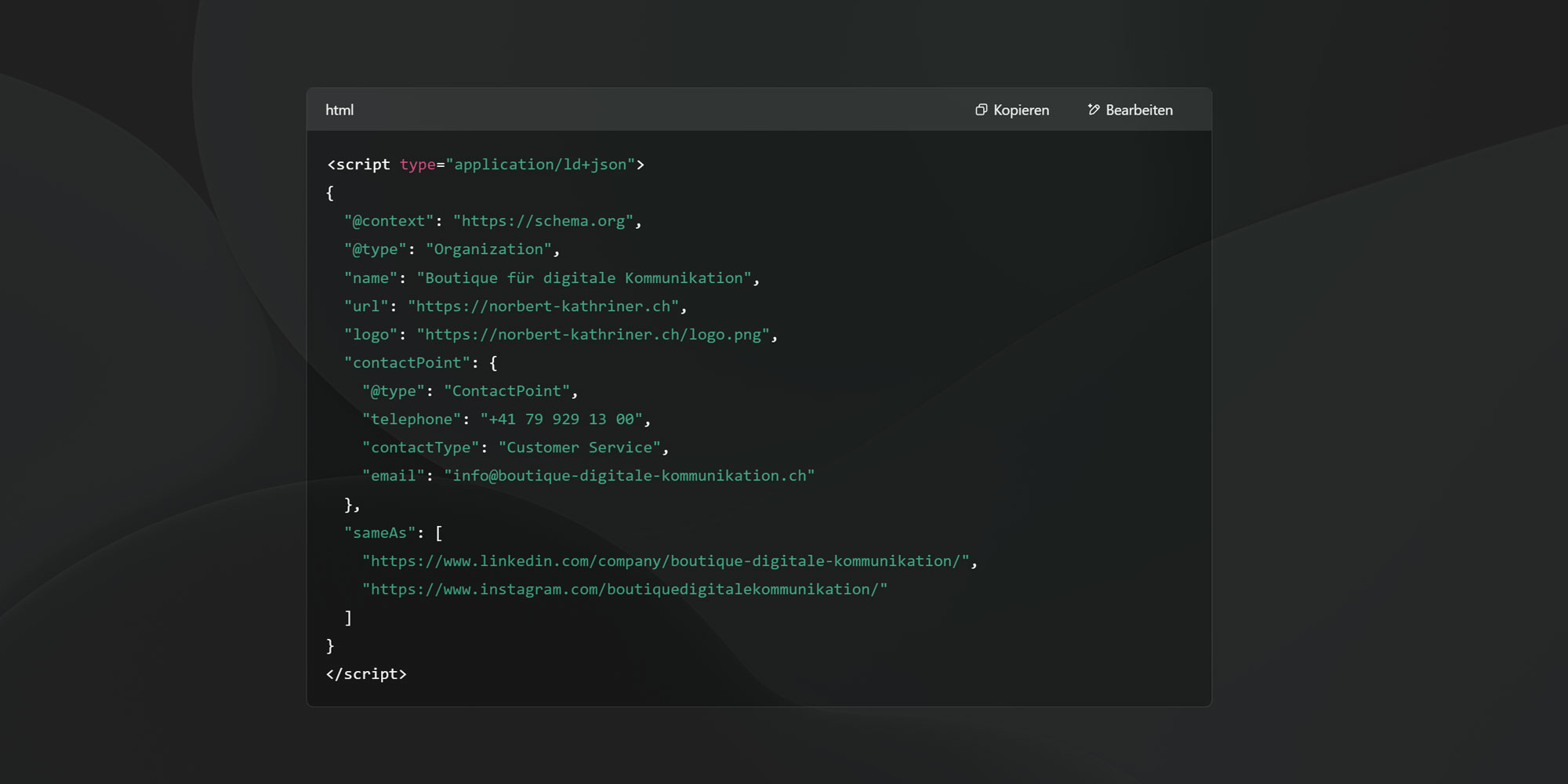
Structured Data (JSON-LD)
Real Data Instead of Gut Feelings—Data-Driven Marketing as the Foundation for Success
Many decision-makers still rely on their gut feelings or general assumptions when it comes to marketing decisions. But in the digital world—especially in the age of AI—intuition and experience alone are no longer enough. The only thing that matters is data-driven reality.
Why Real-World Data Is Indispensable
The dynamic nature of digital channels and the speed at which user behavior and preferences change make data-driven work essential. Real-time data offers you:
- Clarity and accuracy: Decisions are made based on objective facts, not subjective assessments.
- Measurability and Control: You can check at any time to see if your strategies are working and make targeted adjustments as needed.
- Speed and Flexibility: You can quickly adjust and correct your actions as soon as the data indicates a change.
How to Control Your Visibility in AI Models Using Real Data
To effectively control how visible your brand and content actually are in AI-powered searches (such as Bing Chat or Google SGE), you need to strategically rely on real data. Here’s how to implement data-driven marketing in a concrete and targeted way:
- Systematically monitor AI visibility: Use specialized tools to regularly check how often and in what context your brand or content appears in responses from AI models. These AI visibility tools allow you to track whether and how your content is currently being used by AI systems.
- Analyzing and Adjusting Your Content Strategy: If your brand is missing or only partially represented in AI-generated responses, use data-driven analysis to identify which specific pieces of content are missing or need to be updated. Targeted analyses will help you close relevant gaps and effectively adjust your content strategy.
- Optimization Based on User Intent and AI Data: Regularly analyze the actual questions and search terms that users enter into AI systems. With these insights, you can tailor your content even more precisely to actual user intent, thereby increasing your chances of being cited and gaining visibility.
- Conduct regular data-driven reviews: Set specific time frames (e.g., monthly or quarterly) during which you specifically monitor how your AI visibility and the resulting user interactions are evolving. This allows you to identify trends, opportunities, or challenges early on so you can respond immediately.
- Create transparency using real data: Monitor which specific content AI models tend to pick up on and cite. This will give you clear insights into which topics, formats, and structures work best, allowing you to build on them to develop targeted content.
With these data-driven methods, you’re no longer managing things blindly—instead, you have full control at all times over how visible and effective your content and your brand actually are in the AI and digital world.
”Anyone who fails to implement targeted AI optimization over the next 18 months risks becoming invisible in the digital landscape. The growing dominance of AI models will completely reshuffle the deck. Traditional SEO is a thing of the past; AI optimization is the new digital must-have: In the future, it will determine who gets noticed and who is simply ignored.
Norbert Kathriner
Trust as a Ranking Factor—Here’s How to Become a Reliable Source for AI Models
Relevance isn’t just about content—it’s about trust.
AI models such as ChatGPT, Bing Chat, and Perplexity are increasingly evaluating sources based on “trust signals”—that is, information that indicates a company or brand is reputable, relevant, and reliable.
These signals are particularly powerful:
- Mentions on high-authority third-party sites: If you’re mentioned in articles on well-known platforms (e.g., trade magazines, industry portals, Wikipedia, Wikidata), your brand is considered “recognized.”
- Backlinks from trustworthy domains: AI models take linked sources into account not only for evaluating content but also for reputation signals. In this context, it’s not so much the quantity that matters, but rather the quality and thematic relevance.
- Social Proof & User Feedback: Mentions on LinkedIn, in comments, reviews, or as a source in discussions (e.g., Reddit, Quora, Stack Overflow) increase the likelihood that your content will be recognized as relevant.
- Complete transparency on your website: legal notices, privacy policies, author profiles, and structured information (e.g., about your team, methods, and case studies) build trust—even at the machine level.
Why GPT & Co. pay attention to this:
GPT models like ChatGPT were trained on text from the open web —with a strong focus on linked, citable, structured content. If your content is already embedded in these sources, you’re not just visible—you’re trustworthy.
Recommended Action:
- Strategically place content on third-party, credible platforms —not just on your own site.
- Use structured data (JSON-LD) to show GPTBot & BingBot: “This is a real organization, with real people and real services.”
- Link specifically to articles in which you are mentioned or quoted —this strengthens your entity authority.
- In the medium term, incorporate testimonials, LinkedIn references, and external mentions into your “About Us” and project pages.
Conclusion: Visibility, Conversion, and Data—Your New Formula for Success
Digital visibility is no longer just a matter of Google rankings. Today, AI models like ChatGPT, Bing, and others determine whether your target audience even notices you—and they do so right where relevant decisions will be made in the future: directly in the AI’s responses.
Are you wondering, “How can I gain visibility in ChatGPT?” or “How can my brand gain visibility in ChatGPT?”
But visibility alone doesn’t generate revenue. The key to success is ensuring that your content is not only visible but also clearly transaction-oriented and delivers immediately measurable results.
In the long run, it’s not enough to act based on gut feelings or past experience. Only a consistently data-driven approach allows you to know exactly, at any given time, whether your strategies are working and how you can quickly make adjustments. This data-driven clarity becomes a decisive competitive advantage in an increasingly AI-driven digital world.
Frequently Asked Questions About Visibility in ChatGPT and Other AI Systems
What Companies Need to Know About Visibility in ChatGPT.
How can I make my brand visible on ChatGPT?
A brand’s visibility in ChatGPT is not achieved through traditional SEO optimization, but rather through its presence in structured, machine-readable sources. High-quality mentions on platforms such as Wikipedia, specialized media outlets, or renowned industry portals are crucial, as is technical accessibility for AI crawlers (e.g., GPTBot, CCBot). Only content that is openly accessible and clearly assigned to a topic cluster is recognized and processed by AI models.
How can I check my brand’s visibility in AI systems like ChatGPT or Perplexity?
A systematic review is conducted in two stages: First, through targeted queries in AI systems—for example, using prompts like “What do you know about [brand]?” in ChatGPT, Bing, or Perplexity—and second, through monitoring tools like Rankshift or BrandMentions, which analyze citations and mentions. For small teams focused specifically on ChatGPT, Beamtrace provides a lighter entry point, with a 14-day trial and plans starting at $20 per month when billed annually. In addition, manual testing in AI chatbots and the analysis of source references help to gauge actual presence.
What exactly is AI visibility, and why is it crucial for businesses?
AI Visibility refers to the likelihood that a brand, a company, or specific content will be selected as a source by generative AI models (such as ChatGPT or Perplexity) and incorporated into their responses. This visibility is increasingly determining whether a brand is even noticed in the digital space—regardless of traditional Google rankings. Without AI visibility, the brand effectively disappears from the digital landscape in the new zero-click ecosystem.
What tools can help monitor brand visibility in ChatGPT and other AI systems?
Specialized tools such as Rankshift, BrandMentions, or Mentionlytics, which automatically track AI-generated citations and mentions, are well-suited for systematic monitoring. In addition, regular manual testing is recommended: By using targeted prompts in ChatGPT, Bing, or Perplexity, you can determine whether and how your brand is cited as a source. It’s important to consistently document these tests to identify trends and changes early on.
How do I optimize content specifically for ChatGPT, Perplexity, and similar tools?
AI-optimized content is structured in a conversational manner, clearly organized from a technical standpoint, and tagged with distinct entities (e.g., organization, person, product). Key factors include: Open accessibility for AI crawlers, structured data in JSON-LD format, consistent use of FAQ and how-to sections, and targeted placement on trusted third-party platforms such as Wikipedia or industry portals. Traditional keyword optimization clearly takes a back seat in this context.
What Is Transactional Content in the Age of AI—and Why Is It So Important?
Transactional content isn’t aimed at reach or mere visibility, but at specific actions: inquiries, purchases, downloads, or contact requests. In the context of AI, this means designing content so that it not only appears in AI responses but also includes clear calls to action (CTAs), value propositions, and context-relevant offers. Only those who bridge the gap from pure information to a transaction will remain economically visible in the new zero-click ecosystem.
What role do Wikipedia and other third-party platforms play in visibility within AI models?
Wikipedia, Wikidata, and other highly authoritative third-party platforms serve as preferred sources for many AI models. A well-established presence on these platforms significantly increases the likelihood of being recognized as a trustworthy entity and cited in AI responses. What matters is not merely the existence of an entry, but its quality, timeliness, and the number of independent sources that corroborate the brand.
What NO LONGER works in AI optimization today?
Outdated SEO tricks such as keyword stuffing, hidden content, or link farms are largely irrelevant to AI models. Even short-term attempts at manipulation (e.g., paid mentions or automated backlinks) are detected and ignored by modern AI systems. Relevance stems from semantic depth, genuine content authority, and consistent linking to credible sources.
How can my brand remain visible in the long term—despite constant changes in the AI landscape?
Long-term visibility requires a systematic approach: continuous improvement of content quality, maintaining and expanding thematic authority, and a willingness to continually adapt content structures and technical standards to the evolution of AI systems. A willingness to learn, data-driven optimization, and targeted positioning on third-party platforms are the key factors for success.
What are the most common mistakes in AI visibility—and how can they be avoided?
Often underestimated factors include a lack of technical accessibility (e.g., blocked AI crawlers), imprecise brand positioning, and ignoring third-party platforms such as Wikipedia. Relying on gut instinct rather than real-time data also leads to invisibility. These mistakes can be avoided through a data-driven, structured approach and by consistently aligning all content with dialogic, AI-compatible structures.


What We Can Do for You, Specifically

Targetedly Strengthen Organic Presence
We ensure that your brand and content are featured in relevant, authoritative sources such as Wikipedia, industry publications, and renowned knowledge platforms. This helps us specifically increase the likelihood that AI models will include you in their responses and cite you preferentially.

Create content with semantic clarity and conversational capabilities
We work with you to develop high-quality content that is precisely tailored to real user queries and typical AI prompts. This allows us to effectively increase the relevance of your content and the likelihood that it will be selected and cited by AI models.

Creating High-Conversion Content for Measurable Results
Our agency helps you make your content not only visible but also transaction-oriented. We focus on clear value propositions, strong calls to action (CTAs), and strategic placement of offers to effectively convert visitors into customers.

Ensure continuous AI monitoring and data-driven optimization
We regularly monitor how visible and effective your content is in AI-powered searches. Based on detailed analyses and real-world data, we continuously optimize your strategy to ensure long-term, sustainable success for your business.
Join us now in implementing these three key principles—AI visibility, transactional content, and data-driven marketing. This will not only secure your brand’s digital presence but also deliver sustainable, measurable results and competitive advantages.
Contact us now for a no-obligation initial consultation —before your brand becomes invisible online.
Afterword: How This Article Itself Was Made Visible
This article isn’t just about strategy—it’s about putting theory into practice.
The following four measures were implemented to ensure that this post is visible even in AI systems (such as ChatGPT, Perplexity, and Bing Chat), search engines, and open knowledge graphs.

Step 1: Structured linking via Wikidata
The article, the author, and the agency are registered as semantically linked entities in the global knowledge graph.

Step 2: Anchoring the Topic in Wikipedia Discussions
Proactive proposal to incorporate AI-SEO as a brand strategy in relevant Wikipedia articles.

Step 3: Sharing via Medium & LinkedIn
The English version was published on Medium and also shared on LinkedIn to generate backlinks, shares, and traffic.

Step 4: Visibility in AI Response Systems
GPT models and response systems recognize the semantic connection between the author, the agency, and the content.
Who makes it into ChatGPT’s answer? Who is recommended by ChatGPT & Co – and who is only mentioned in passing?
Warning: slightly nerdy.
This article shows step by step how large language models really construct their answers – from the source search to the recommendation.
Sources
An example solution for monitoring whether and how brands are mentioned in AI chats; several similar tools exist.
https://platform.openai.com/docs/plugins/introduction
Technical explanations on how to provide your own data interfaces for ChatGPT (keyword: GPT plugins).
https://www.anthropic.com/index/claude
Official information about Claude (Anthropic’s LLM), including details on the training approach and sources used.
Representative of forums and Q&A platforms from which many LLMs draw their expertise.
https://www.linkedin.com/in/patrickstox/
Discussions about “LLM-SEO” and Schema markup; often critical examinations of common SEO myths in technical articles.
https://www.searchenginejournal.com/
Montti regularly publishes articles on Schema.org, LLM optimization, and AI search topics; he is critical of exaggerated expectations regarding markup.
Google – Search Generative Experience (SGE) Blog
Information about Google’s experimental AI search (SGE), insights into how it works and how it processes sources.
Common Crawl – Official Website
A free web dataset that serves as a major part of the training corpus for many LLMs (including GPT).
Google Search Central – AI Overviews and Your Website
This documentation explains how AI Overviews work, how they display links, and how you can control whether your content appears in them.