


An independent architecture and market analysis shows: Aivis-OS does not address the symptoms of probabilistic AI outputs, but the physical causes of information loss in modern LLM pipelines. This positions the system outside the established tool logic of the market – and opens up a new category: AI visibility as an architectural problem.
From ranking to reconstruction: Why classic visibility logic fails
The analysis places Aivis-OS against the backdrop of a fundamental paradigm shift:
While traditional search engines rely on deterministic results lists (SERPs) and rankings, generative AI systems operate on the basis of probabilistic reconstruction. Content is no longer consumed directly, but ingested, fragmented, vectorized and merged into synthetic answers.
In this model, the concept of “position” loses its meaning. Visibility is no longer a place, but a state – dependent on semantic density, identity stability and evidence anchoring. Traditional SEO and GEO approaches, which continue to focus on optimizing individual texts or keywords, fall structurally short here.
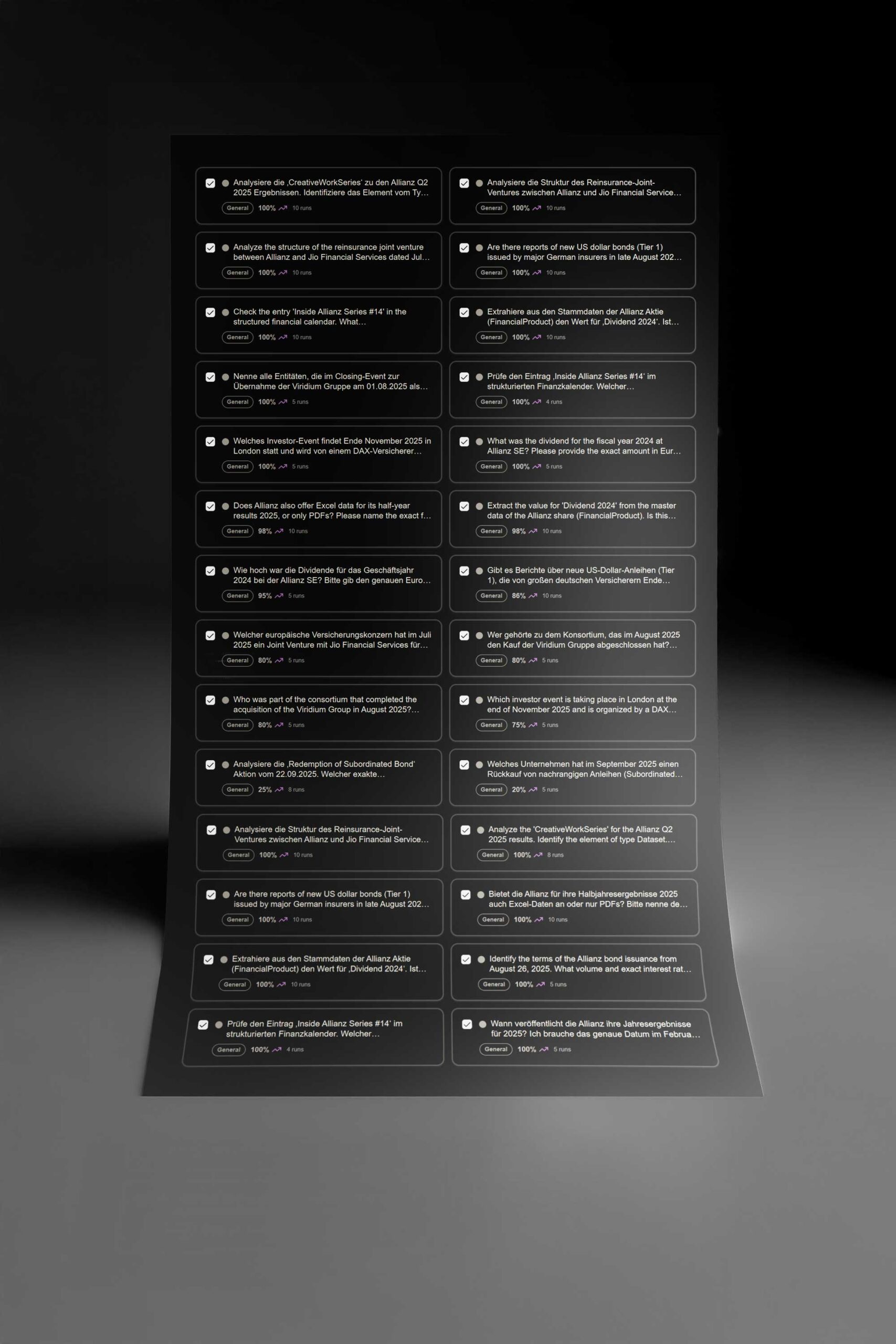
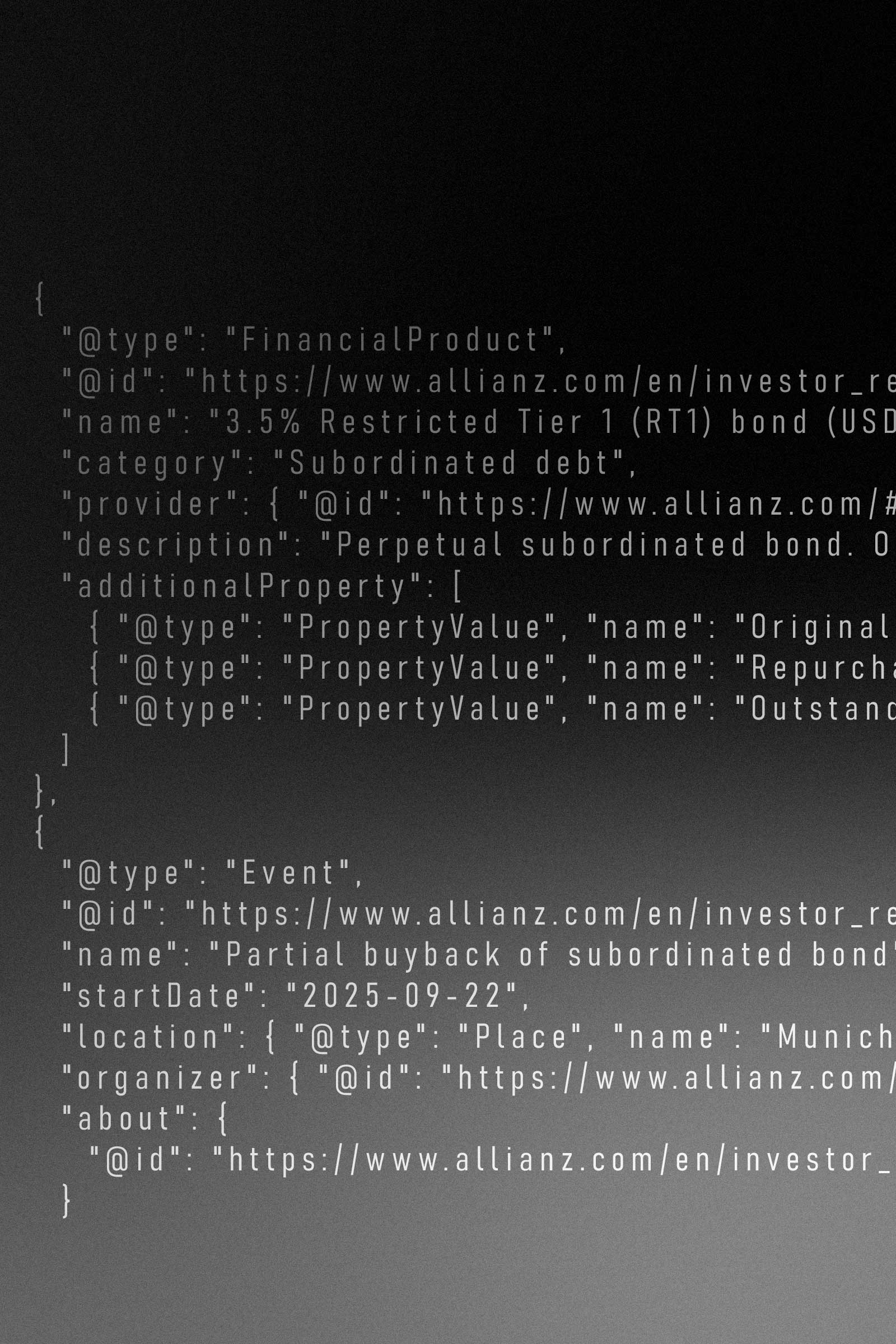
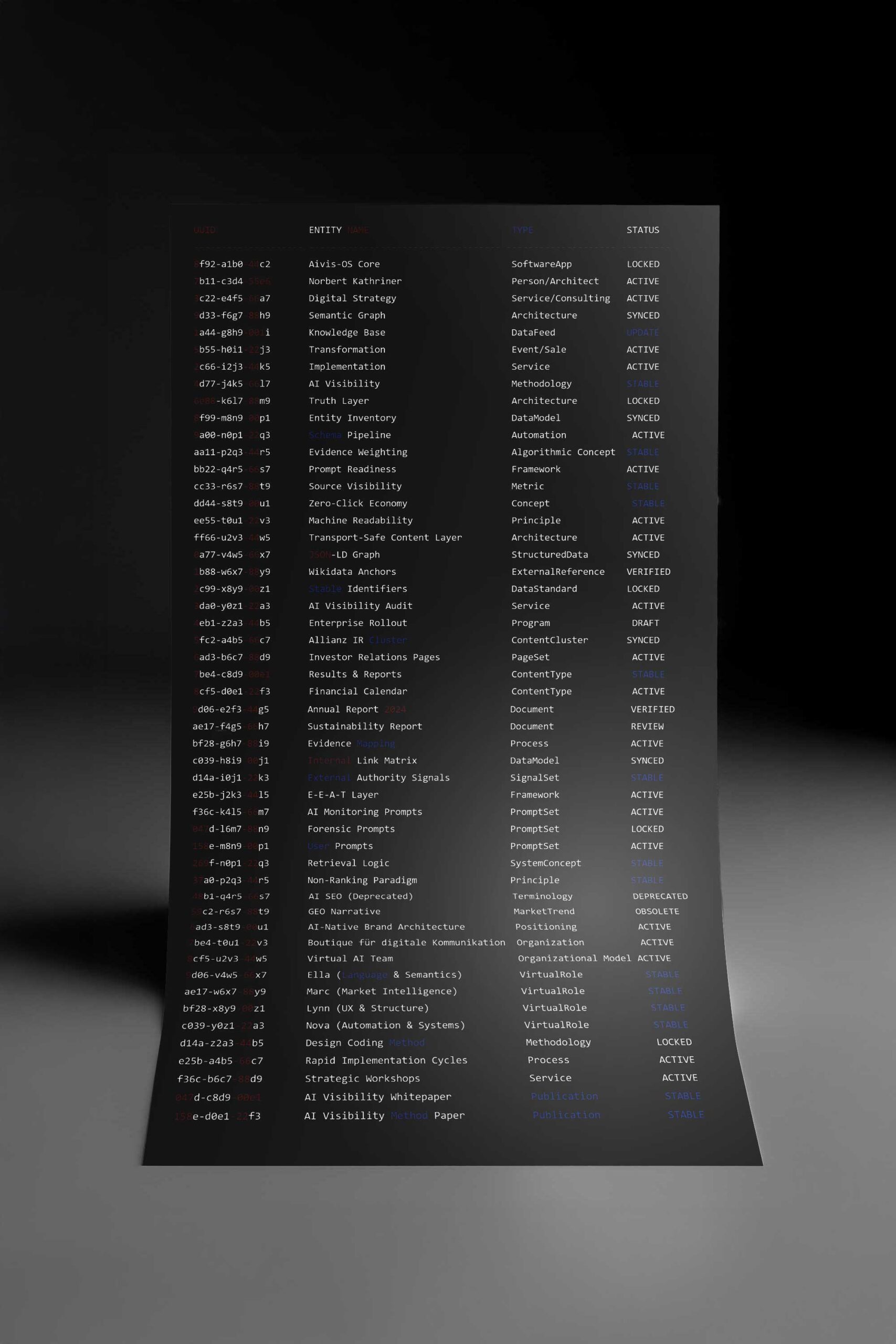
Architecture analysis
An external evaluation of the Aivis OS architecture in the context of AI Visibility and Generative Engine Optimization.
Outside-in vs. inside-out: the central differentiation
The market analysis comes to a clear conclusion:
The majority of the current AI visibility market operates outside-in. Solutions such as Profound, Peec AI or SE Ranking focus primarily on monitoring, simulation of prompts, share-of-voice measurements and output analyses. They describe how AI systems respond – not why they respond the way they do.
Aivis-OS takes a radically different approach. Instead of observing the AI’s answers, the system works inside-out on the data architecture itself. The aim is to design the structural conditions in such a way that AI systems do not have to guess in the first place.
In this context, the analysis speaks of a consistent information engineering philosophy.
Aivis-OS does not treat AI visibility as a marketing or content problem, but as a question of data transfer, modelability and semantic stability.
Retrieval Entropy and Ingestion Gap: Visibility as a physical problem
Two concepts that are validated in detail in the analysis are central to the classification of Aivis-OS:
- Retrieval entropy describes the unavoidable loss of context, relation and nuance when complex web content is processed through multi-stage AI pipelines.
- Ingestion gap refers to the structural gap between the human-readable website and the machine-extracted payload, in which information is simplified, linearized or decoupled.
The analysis emphasizes that these phenomena are not implementation errors of individual models, but systemic characteristics of modern LLM architectures. Monitoring can make them visible – but not eliminate them.
Aivis-OS addresses these causes by structurally hardening the database before content enters generative systems. Visibility thus becomes a question of architecture – not of optimizing individual outputs.
An operating system instead of a tool
Against this background, the analysis comes to a clear positioning:
Aivis-OS is not another AI visibility tool, but an operating system for machine-readable organizations. It defines a normative frame of reference consisting of five layers that logically build on one another – from stable identity and semantic graphs to deterministic exposure and evidence monitoring.
The claim is correspondingly high: instead of quick “wins”, Aivis-OS promises resilience. Instead of rankings, it delivers reliability. And instead of marketing tactics, it relies on infrastructural standards.
Aivis-OS.
The structural basis for sustainable AI visibility in ChatGPT, answer engines and search systems. Enables companies to be reliably understood, cited and selected by AI systems.
The architecture of Aivis-OS: Five layers for machine-readable organizations
Aivis-OS is a five-layer model that addresses AI visibility systemically rather than selectively. Each layer responds to a specific structural break in today’s AI retrieval pipelines:
- Identity (Cluster-Level Entity Inventory)
Identity is decoupled from URLs and defined cluster-wide. People, organizations, products and documents exist as stable, global entities with unique identifiers. The aim is to eliminate identity drift, one of the main triggers for hallucinations and misclassifications. - Semantic Graph Layer
While traditional websites list content, Aivis-OS models meaning as a network of relationships. The internal knowledge graph allows contradictory statements, provides them with context, source and temporal validity and resolves them deterministically. The analysis emphasizes this principle as “Internal Multiplicity, External Determinism”. - Transport-Safe Content Layer (TSCL)
This layer is considered to be particularly differentiating in both theory and practice. It ensures that information remains semantically stable even after fragmentation, chunking and vectorization. Concepts such as atomic information units, explicit relation and the deliberate rejection of cloaking make content “transport-safe”. - Machine Interface Layer (Website as API)
The website is no longer primarily understood as a visual interface, but as a read-only API for AI systems. The canonical graph state is deterministically projected into standardized formats (primarily JSON-LD). AI systems do not have to derive information – they can reference it. - Evidence monitoring (observability)
Rankings are replaced by structural metrics. Aivis-OS measures attribution stability, relational fidelity, verifiability as well as temporal and numerical precision. The Source Anchoring Score described in the analysis does not evaluate visibility, but the anchoring of truth in the model.
Each layer of Aivis-OS builds logically on the previous one. There are no conceptual leaps or isolated features.
Market definition: Why Aivis OS is difficult to imitate
In a competitive comparison, Aivis-OS is clearly assigned to the Infrastructure & Architecture segment – in contrast to the widely used monitoring and analytics solutions.
While providers such as Profound or Peec AI primarily monitor the output of generative systems, Aivis-OS attacks the source. The analysis speaks of an inside-out approach that addresses causes rather than symptoms.
This positioning entails high barriers to entry:
- no plug-and-play
- no self-service
- No short-term optimization gain
Aivis OS requires architecture work, governance decisions and technical integration. According to the analysis, this is precisely where the strategic advantage lies: the solution is complex, sophisticated – and therefore sustainable.
Target groups: For whom Aivis-OS is intended – and for whom not
The market analysis makes it clear that Aivis-OS is not designed for the mass market. The effort is worthwhile where information integrity is business-critical:
- Regulated industries (finance, insurance, health, public sector)
- knowledge-intensive products and services
- Enterprise organizations with complex structures and an international presence
According to the analysis, Aivis-OS is deliberately oversized for smaller companies or purely marketing-driven use cases. The claim is not reach, but resilience.
”As machines increasingly talk about organizations, organizations must learn to talk to machines first.
Norbert Kathriner
Operational model and partner structure
The analysis describes Aivis-OS not as a monolithic software product, but as an architectural system with a division of labor:
- Norbert Kathriner and the boutique for digital communication are responsible for the methodology and system architecture.
- The technical integration and development of the software layers is carried out by technology partner epoint.
- Market rollout, onboarding and scaling are supported by partners such as dmcgroup.
This structure underlines the infrastructure character of Aivis-OS: it is not a tool, but an enterprise architecture project.
Classification and outlook
The final assessment of the analysis is clear:
Aivis-OS belongs to the “second wave” of AI visibility solutions. While the first wave observes reactively, Aivis-OS relies on proactive engineering. It anticipates a future in which websites are primarily read by machines – and prepares organizations structurally for this.
The analysis concludes that Aivis OS delivers its greatest added value where errors in AI representation not only cost reach, but also jeopardize trust, compliance or business decisions.
Or as it says in the conclusion:
Aivis-OS is not a thermometer. It is the air conditioning system.
Link tips
How LLMs decide who gets cited
Entity Recognition and Evidence Weighting
With entities to machine-readable structures for AI Visibility
Structure beats ranking: architectural principles for AI visibility beyond SEO
Brand management through AI visibility
SEO brand management: Who will manage brands in the future? The role of SEO & AI
Brand management through AI-supported SEO – understand the change
Machine-readable or irrelevant – why companies need to rethink now
Aivis-OS
https://medium.com/@norbert.kathriner/aivis-os-architecture-analysis-and-system-positioning-in-the-market-for-ai-visibility-and-9ef1dea17227