

A technically readable website can present a brand that is strategically unreadable. That’s why we first determine what you stand for, what information is relevant, and how you come across.
For companies that can do everything—except say what they stand for.
Decide
“Everything you do should reinforce your brand positioning. Everything.”
Norbert Kathriner
Before we talk about technology
Today, your website speaks even when you’re not there: through responses generated by an AI system based on its content.
A system like this takes whatever it finds and rephrases it in its own words. If an old webpage mentions a former project partner, that person might be listed as a current employee. Then your name appears in the result, along with a skill that you don’t actually have at the company. This makes you visible, but it doesn’t accurately represent who you are.
I know this from my own experience. My website had 16 service pages, and each one began with “Your agency for ….” Sixteen times, an agency for something different. The range of services grew broader, but its meaning didn’t become any clearer. Simply listing everything you can do doesn’t tell people why they need you.
If your website is inconsistent, you leave the interpretation up to others. That’s why I don’t start with the technical aspects, but with the decisions behind them:
- What you stand for: who you help solve which problem, and why you, specifically.
- What information to include: names, numbers, and roles—each with its context.
- How you come across: words, attitude, and the phrases you want to leave a lasting impression with.
If no one within the company can say what the brand stands for, a new website won’t make it any clearer. It’ll just make it look nicer.
Request an Initial Consultation
What You Stand For
The watering can spreads the water. The magnifying glass focuses it. Positioning means directing your abilities toward a single point.
Many years ago, a friend and colleague of mine, Ewald Pichler from the dmcgroup, asked me a simple question: “How do you want to spend your precious time?” I haven’t done any pitches since then. For a company, the question is the same: What mission do you want to be called to, and by whom?
Positioning starts with this task. Who has it, how urgent is it, and what are you being compared to? Only then does what you do differently matter. “Innovative,” “holistic,” and “tailor-made” are surprisingly unhelpful here. Your competitors already have those same words on their websites.
That doesn’t mean you have to give up any of your skills. An architect doesn’t forget structural engineering just because he specializes in renovations. What matters is what you’re hired to do and what skills support that commitment. For me, the key is machine readability. Everything else I can do supports that goal.
What I’m going to discuss with you
In what situations your most important customers seek help, and what factors influence their decisions.
Who they compare you to—and which of your differences really matter.
What you reliably deliver, what proves it, and what services are behind it.
You’ll receive a positioning statement.
Under (Target Audience), (Brand) is the brand for (Frame of Reference) that (Point of Differentiation) because (Reason for Belief). We then use this statement as the benchmark against which we measure every offer, every argument, and every page. It doesn’t have to win any advertising awards. It has to make decisions possible.
Curious? Then read this…
Which information applies?
Both years of establishment could be correct. What matters is what was established in each case.
Maybe your business was founded in 1998 and the current company was established in 2015. That’s not a contradiction, as long as someone explains it. But on established websites, such details often stand alone. You know the context. Your readers don’t.
On my own website, my work experience was listed as three different numbers. It was clear to me what each one meant. But not to a reader—and certainly not to a machine. It might just as easily attribute the longest number to my company. Incidentally, using the same number everywhere would be an elegant way to misrepresent history.
That’s why I clarify identities, roles, services, figures, and prices in their proper context. We correct any genuine errors. We explain any justified discrepancies.
What I’m going to discuss with you
What important information is listed on your website, in profiles, directories, and with partners.
Where they contradict each other, where the reference is missing, and which version is outdated.
Which statement is correct, how can you verify it, and who will be responsible for updating it in the future?
You’ll receive a fact sheet.
A list of the information on which your communication is based: names, relationships, achievements, figures, and areas of responsibility—each with a source and a date. What was previously true remains clearly identified as such. What is still open remains open until it is clarified. Later on, anyone publishing on your behalf will draw from this fact sheet.
How You Sound
You can sound completely consistent and still remain completely interchangeable.
A brand only sounds like you when people hear what you’ve understood, what you stand for, and how you talk to customers. A tagline can distill that. It can’t do the work for you.
Machine-readable doesn’t mean bureaucratic. In body text, you’re free to tell stories, highlight key points, and use imagery. We keep only headlines and short answers simple: they convey the essence of the message even without the accompanying paragraph. An image can spark an idea. A new, fanciful name for an old service, on the other hand, simply makes it harder to find.
To achieve this, we develop:
- Names: the names of people, companies, products, and services, including their abbreviations and how they relate to one another.
- Voice: Tone, manner of address, word choice, and tact, illustrated with real sentences. A list of “competent, authentic, approachable” isn’t enough for me here.
- Key messages: what your customers should understand, along with the arguments addressing their various questions. If needed, this can be developed into a tagline.
I want your writing to reflect who you are and to convey a message. One without the other isn’t enough.
What I’m going to discuss with you
Where your voice comes through in your writing, and where you use the usual industry jargon.
Which phrases explain your value, which ones show your attitude, and which ones just try to sound important.
What your offering is called and how that same message comes across on the website, in sales, and with partners.
Here are your writing guidelines.
A brief working document with names, key messages, and example sentences. It shows what your text sounds like, which phrasing can be counterproductive, and how to structure a statement for different readers. The language can evolve. Facts, offers, and tone remain recognizable, even when AI assists with writing.
Curious? Then read this…
Here’s how I do it
Das Ziel: Du kannst in einem Satz sagen, wofür du stehst, und alle, die für dich schreiben, können es auch.
Dafür brauche ich Einblick in dein Geschäft und Menschen, die entscheiden dürfen. Was schon klar ist, übernehmen wir.
- Reading. I read the agreed-upon pages, profiles, and key external sources, and compare the public image with your current business and your customers’ questions. Random checks using AI systems provide clues; a single answer is no substitute for a thorough investigation.
- Decide. Together with you and the relevant stakeholders, I clarify the target audience, category, unique selling proposition, and the role of your services. If there are contradictions, we seek out verifiable facts. If there’s a lack of knowledge about customers or the market, we make a note of what we still need to find out.
- Refining. I’ll draft a positioning statement, a fact sheet, and language guidelines, and test them against real-world scenarios: Do they explain your most important offering? Do they help during customer conversations?
- Hand it over. You review and approve it. Any outstanding items are assigned to someone. Then it’s time to consolidate: the direction becomes content.
These decisions set the standard for everything that follows. If you skip them, you’ll end up making them later anyway—only at a higher cost.
Request an Initial Consultation
How a Decision Becomes a Performance

ALLYSCA, Assistance Provider
The offering was there, but its value was lost in corporate jargon. The reorientation began by addressing the questions raised by end customers, sales partners, and clients. This led to new copy, a thematic framework, and a brand identity that aligns with it. Commissioned by and supported by dmcgroup, 2025.
This website
In September 2026, I’m streamlining my operations: I’m going from 16 pages of services to four pages with a clear focus. I am the brand, Aivis-OS is my product, and the LLC is the vehicle. The restructuring is underway.
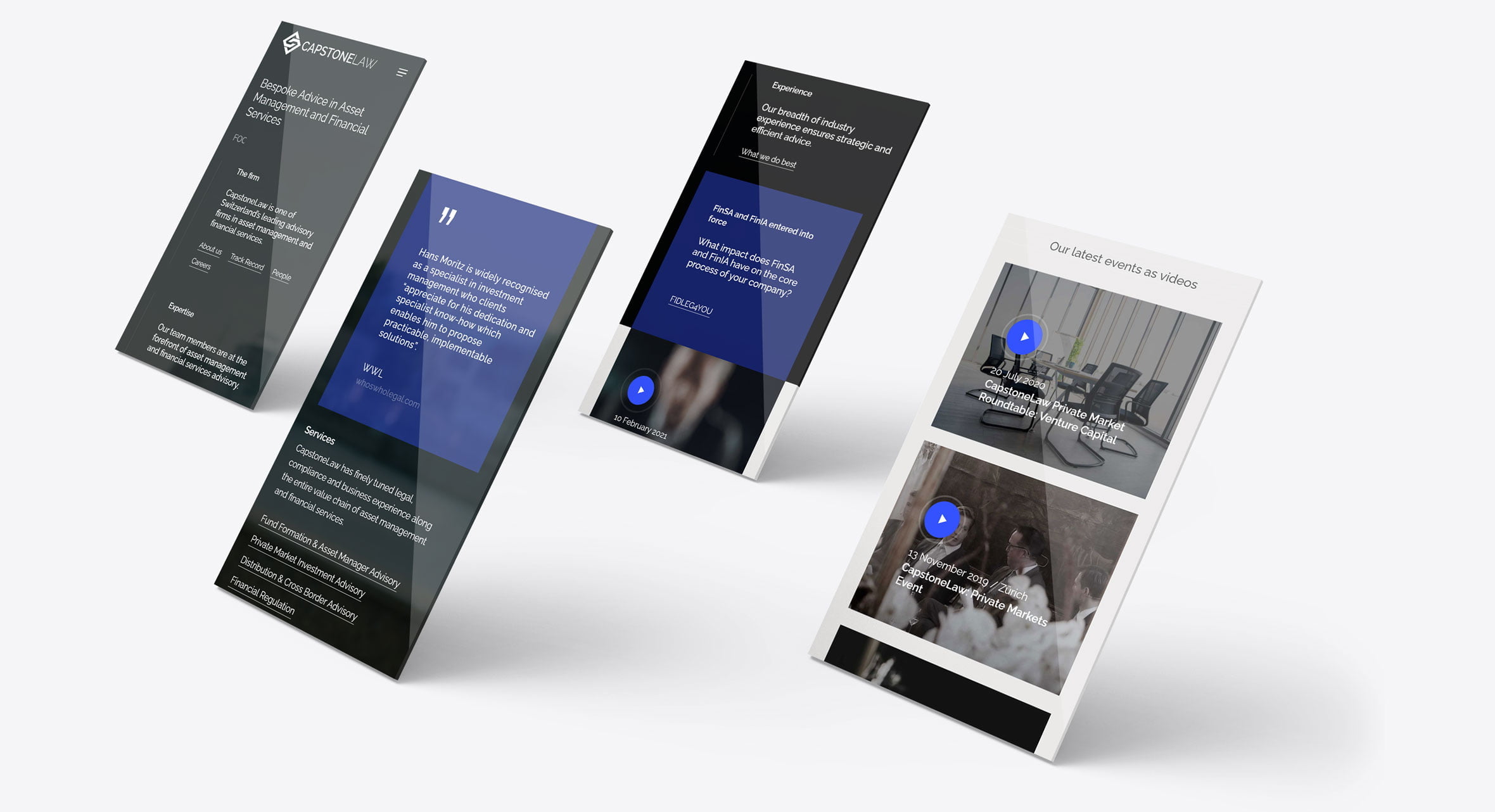
CapstoneLaw
The full spectrum of asset management and financial services, private market investments, investments, distribution, banking and financial regulation, compliance, corporate, transactional, and trading matters. Brand development 2024.
Questions and Answers
Why make a decision before anyone has worked on the technology?
Because the technology can only publish information that has been clarified. It can clearly distinguish between the company, the person, and the product. However, someone must first determine what role these three play in your offering. It’s the same with numbers: a date in the code doesn’t specify whether it refers to the company’s founding or the product launch. That’s decided around the table, not in the source code.
What happens if an AI system finds different founding years for my company?
It can misrepresent your story if it adopts the years without their context. No one can predict with certainty how a particular system will handle this. Our task is simpler: If both years are correct, we note what was founded in each case. If one is incorrect, we correct our own sources and report the error to the relevant external authorities. Two mysterious numbers become a story that can be verified.
What is the difference between positioning and a claim?
Positioning determines who you’re solving problems for, what tasks you’re tackling, and why you’re the right person for the job. The tagline makes part of that memorable. It can be playful, to the point, and spark curiosity. Still, the offering behind it must be clearly explained. A good tagline reinforces a position; it doesn’t replace one that’s missing.
How can I check for myself what AI systems are saying about me today?
Ask ChatGPT, Gemini, or Perplexity about your company, your offerings, and who does what at your company. Open the sources mentioned: Do they support the answer? Note the date, system, and whether a web search was performed. Also ask about your role without mentioning your name. If you’re missing, that’s initially just a finding from this test—not a judgment. Only after several attempts will it become clear whether something is missing, misidentified, or not found at all.
Do I need a new website for this?
No. First, you need clarity on positioning, facts, and language. Whether this leads to a redesign will become clear as the work progresses. Sometimes, targeted changes to content and structure are enough. Sometimes, the website really is no longer a good fit. This is where you lay the groundwork for making an informed decision, rather than rushing into a relaunch.
What if we can't decide?
Then let’s take a closer look. Is there a lack of knowledge about the customers? Do two business units want different things? Or does no one want to remove a cherished service from the front line? Taking a clear stance doesn’t mean shutting down half the company. Often, it’s enough to organize the core offering and supporting capabilities. An artificial compromise in the brand promise doesn’t help anyone. It lasts exactly until the first customer asks a question.
What’s Next.
Once you’re clear on what you stand for, it’s time to refine your message: Which elements support this direction, and what’s still missing? I call this machine-readable brand communication.







Before our conversation, I’ll read through your most important pages. You’ll bring along the mission you want to stand for in the future. Then we’ll compare the two. Usually, it’s easy to see right away where the first decision is missing.
Let’s talk.
Norbert Kathriner
Boutique for Digital Communication