


This is about podcasting in the B2B space—I’m not talking about casual formats like “Two Guys and a Microphone,” but rather podcasts specifically designed for B2B communication, brand building, and strategic content marketing. Podcasts that work. And not just for listener numbers or vanity—but for real impact: visibility, positioning, and customers.
In this article, I’ll show you:
- Why podcasting is so much more effective than traditional formats, especially in B2B,
- how to create a corporate podcast that people will listen to—and find useful—
- what you need to get off to a solid start, both technically and in terms of content,
- and what mistakes you should avoid if you don’t want to sink into obscurity.
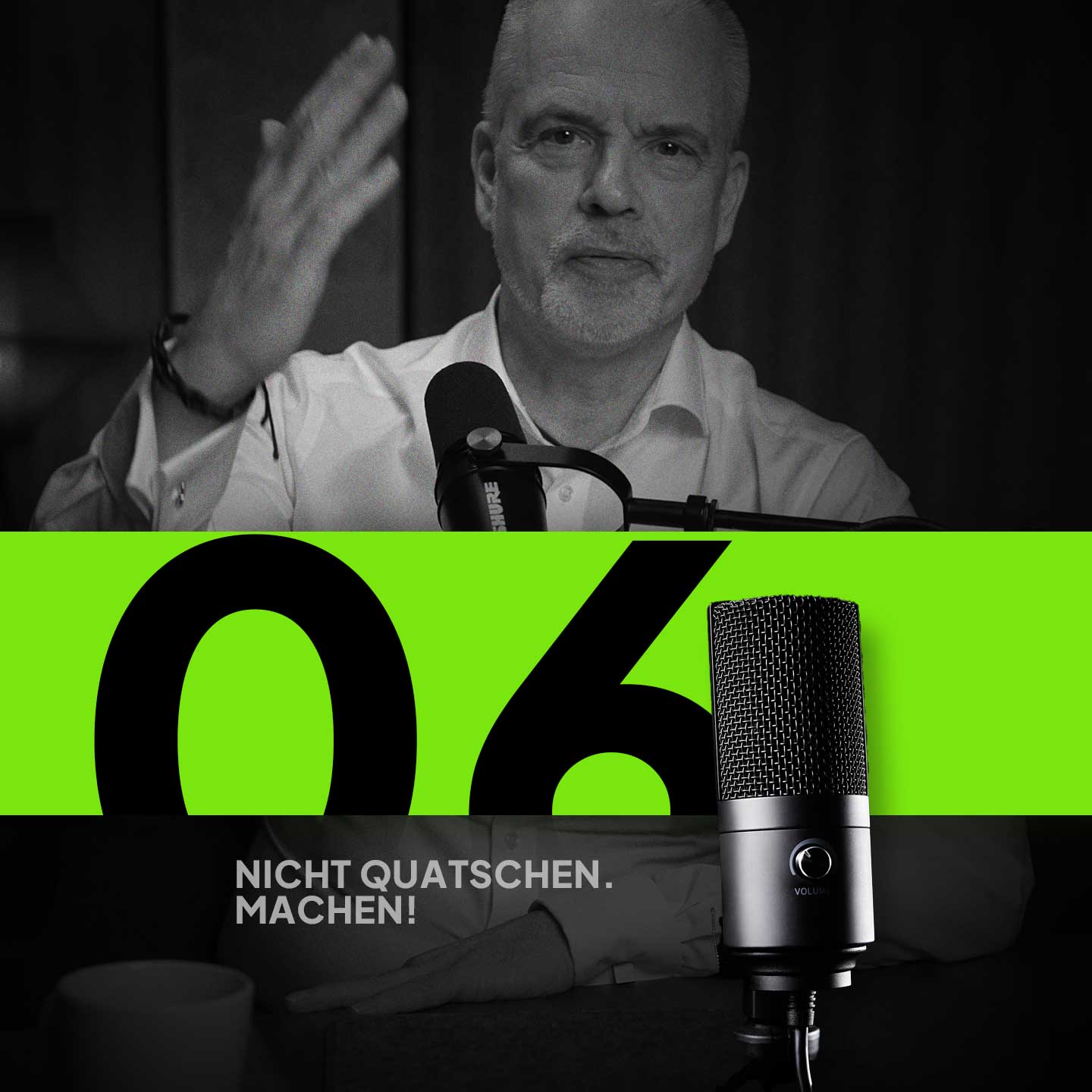
Because what’s coming up next is: Podcasting with substance.
For people with ambition. And for brands with a stance.
This isn’t just a superficial “How to Start a Podcast” quick guide.
This is the complete strategy—with everything you need to redefine your brand through audio content.
If you’re ready to develop a content format that generates not just clicks, but real impact, then keep reading.
A business podcast—often called a corporate podcast or B2B podcast—is not an entertainment talk show, not a self-promotional format, and not an advertising jingle on repeat. It’s a strategic tool. It’s a channel through which you can speak with your target audience—on equal footing, personally, and in a lasting way.
Definition – concise, yet razor-sharp
A corporate podcast is a regularly published audio format that is strategically designed to strengthen a brand’s visibility, trust, and market positioning.
This means: You use your company’s voice not to advertise, but to create relevance. Not to explain products, but to solve your target audience’s problems. And above all: To be heard—literally.
B2B Distinction: Not a “chit-chat podcast,” not “true crime for decision-makers”
Here’s where many people go wrong: they apply the Netflix model to business. Just because true crime shows, “Lanz & Precht,” or sleep podcasts reach millions doesn’t mean your target audience is looking for that kind of content. Decision-makers at small and medium-sized businesses don’t listen to podcasts for entertainment—they listen to get ahead.
That’s why a corporate podcast only works if it:
- is tailored to a specific target audience,
- works in a topic-focused manner,
- and puts your expertise front and center—not your product.
Possible Formats for a B2B Corporate Podcast
Depending on your strategy and resources, you can choose from various formats—here are the most important ones:
Interview
Solo Episodes
Co-Host Talk
Storytelling
Hybrid
The important thing is: The format has to suit you, your topic, and your target audience—not the current Spotify trend.
What a Corporate Podcast Can Do
A well-produced B2B podcast offers you:
- Building Trust Through Your Voice – You Become the Brand Through Your Voice.
- Visibility through niche keywords —via transcripts and show notes.
- Customer loyalty through added value —you become part of your target audience’s everyday life.
- Reach Through Networks – Guests Share Your Episodes, and LinkedIn Responds.
- Enough content to last for months —a single podcast can be repurposed 10 different ways.
And the best part: You don’t need a recording studio, voice-over training, or 10,000 followers. All you need is a clear positioning, a relevant topic, and the courage to make a genuine statement.

Why Podcasting Works in B2B—and Works Like No Other Format
“A podcast is nice to have.” ➡︎ Wrong.
Podcasts aren’t just a toy for marketing departments with too much time on their hands—they’re one of the most effective tools in B2B content marketing, if you use them right.
If you want your business to be seen, understood, and remembered today, it’s no longer enough to just produce content. You need to connect. And no other format achieves that as directly, personally, and lastingly as the human voice.
People listen to those they trust
In B2B, it’s not just the product that matters—it’s who’s behind it. Trust is the currency. A podcast puts you right in the ears of your target audience —no algorithms, no scroll fatigue, no banner blindness.
While everyone else is shouting to get attention, you calmly whisper the solution into their ear.
- 80% of listeners listen to podcasts all the way through.
- The average visit duration is 20 to 40 minutes.
- No other content channel can do that.
This means: Your brand gets the space it needs. Your attitude becomes tangible. Your voice becomes the voice of expertise.
What Podcasts Do Better Than Blogs, Videos, and Social Media
Blog
Video
Social Media Post
Podcast
Podcasting outperforms other formats especially where it counts: engagement and differentiation. Because while a blog is skimmed, a video is skipped, and a post is scrolled past, a podcast is listened to— actively or in the background, but always intimately.
Podcasting—The Perfect Niche for Smart Companies
Especially in B2B, you have an advantage that many other industries don’t have: Top-tier target audiences. Clear challenges. Relevant solutions.
That’s the ideal breeding ground for substantive content—and that’s exactly what podcasting was created for. A B2B podcast isn’t a mass-market format—it’s a precision tool. It doesn’t aim for breadth, but for depth. Not for clicks, but for relevance.
”You don't need 10,000 listeners. You need 100 decision-makers who say, "They get it."
Norbert Kathriner
Thought leadership starts with a voice
Those who are heard are perceived as opinion leaders.
And those who can explain complex topics clearly and in an understandable way become authorities—without having to call themselves that.
A podcast is the stage where you can show:
- Just as you think.
- What you know.
- And who you work for.
Whether you’re an agency, a manufacturer, a consultant, or a SaaS provider: Your brand’s voice is your most powerful weapon—as long as it hasn’t been stripped of its substance. Podcasting lets you reclaim it.
So: If you want to be visible in the B2B space today, it’s not enough to just post anything. You need a format that builds trust, allows for depth, and isn’t disrupted by algorithms. Podcasting is that format.
And the best part? It’s scalable, efficient, and reusable—and getting started is easier than you think.
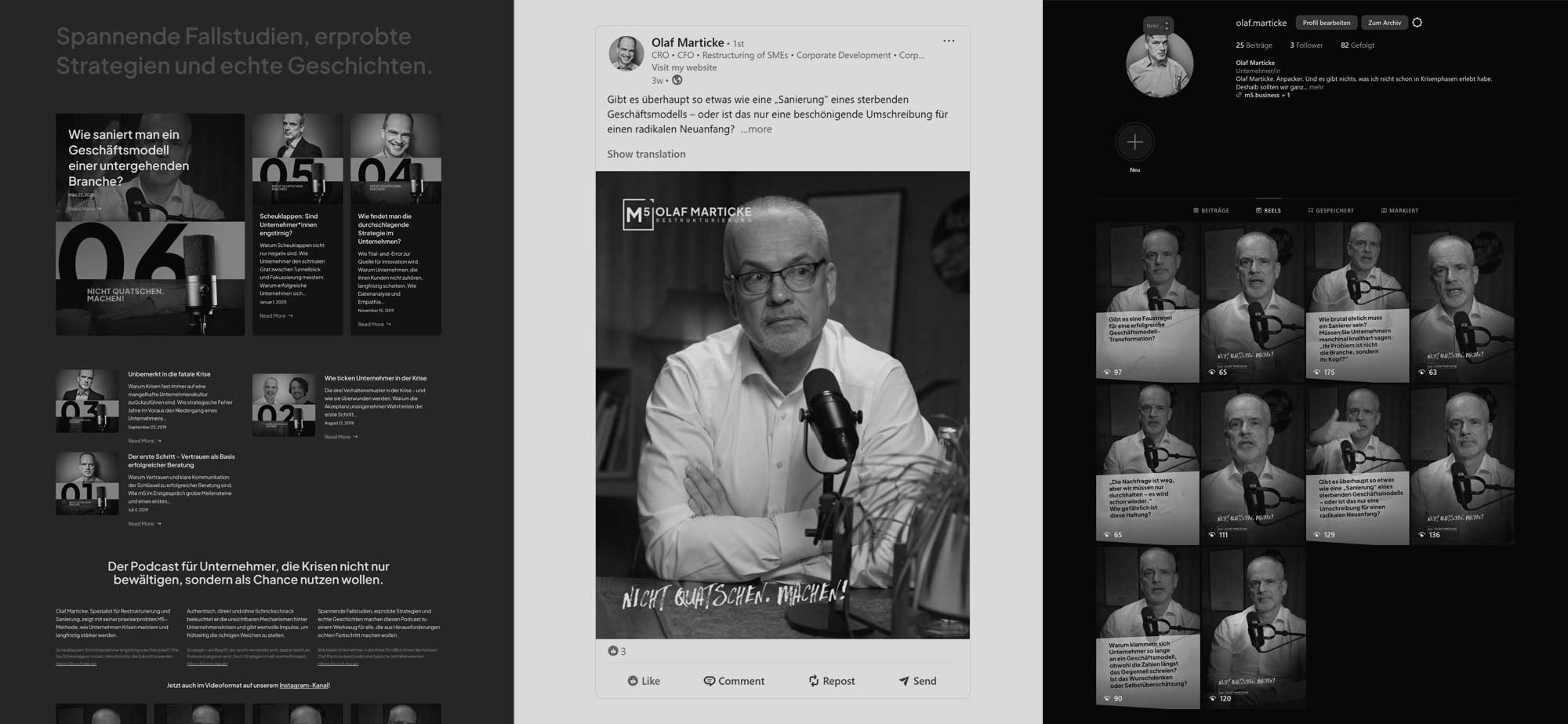
How a Corporate Podcast Can Amplify Your Content Strategy
A podcast isn’t a side project. It isn’t a “nice-to-have.” It isn’t a parallel universe. A podcast—if you set it up wisely—is the centerpiece of your content strategy. It not only builds trust, but also generates content. Lots of it.
Once recorded, a podcast episode can be broken down into 5 to 10 usable formats, each of which generates its own reach and impact.

The Podcast as a Content Hub
Your podcast is more than just an audio track—it is:
- a blog post with a point of view,
- a LinkedIn post with a punchline,
- a quote for your sales presentation,
- a LinkedIn carousel,
- a newsletter opener,
- A slide for your next webinar.
You create one in-depth piece —and distribute it widely. This saves resources, increases visibility, and finally gives your communication a consistent storyline. As you can see, a strong episode isn’t just a drop in the feed—it’s a content ecosystem.

How to Get the Most Content ROI Out of Every Episode
Starting point: You publish a new episode—for example, an interview with an expert on the topic “The Future of Sales in the Machinery Industry.”
From this, you can generate:
- Transcript → as an SEO-optimized blog post
- Quote graphics → for LinkedIn, Instagram, or X
- LinkedIn post → with a teaser statement, problem overview, and call to action
- Newsletter Introduction → featuring 3 insights + a link to the episode
- Audiogram (Short Clip) → 30 seconds for social media or a WhatsApp Story
- Content snippet for a slide or white paper
- FAQ Answers → as website content or support articles
And suddenly , instead of just one episode, you have a content cluster that makes an impact on every level—SEO, thought leadership, and engagement.

Topic Planning: Podcast First—The Rest Will Follow
Most people do it wrong: They write blog posts, shoot videos, post whatever comes to mind—and then wonder if maybe they should try doing something with audio.
Let’s flip it around: Start with the podcast. Why?
- Because spoken words come across as more authentic than written ones.
- Because you develop ideas faster when you talk about them.
- Because you seamlessly combine storytelling, positioning, and personality.
The spoken word then becomes written, visualized, and shared content. You don’t have to do everything twice—you just have to recycle it strategically.

Repurposing: The Key to Efficiency
Repurposing doesn’t mean “copy and paste.” It means taking the core of a message—and presenting it in new ways across different media formats.
- One episode = blog post with additional context
- The Best Quotes = LinkedIn Headline
- Three bullet points = carousel post
- Your Questions = SEO FAQ
- The audio clip = Instagram Reels with an audiogram
And the best part: You say everything once—but you’re heard ten times over.

Content Strategy with a Podcast: The Benefits for You
- Consistency: A podcast gives your content rhythm and structure.
- Scalability: You can achieve more output with less effort.
- SEO Impact: Each episode provides keyword-relevant content when you transcribe and add links.
- Branding: Your brand gains a distinct tone, attitude, and uniqueness.
- Efficiency: No more “What should we post today?” moments—the podcast schedule dictates the content plan.

The future of content marketing is audio-first.
Images are fleeting. Texts are skimmed. But a voice? A voice endures. It creates a sense of closeness, trust, and personality.
If your podcast is a hit, you’re more than just a business. You are a voice. A face. A point of view. And that’s worth more than any ad campaign.

Choosing a Format, Hosting, and Production—How to Get Off to a Smart Start and Avoid Sounding Like an Amateur
A corporate podcast doesn’t need a studio atmosphere, a radio jingle, or a professional voice-over artist. But it does need: structure, clarity, recognizability, and a strong voice.
Not in the sense of a “perfect voice-over voice,” but in the sense of: Attitude. Personality. Precision.
Choosing a Format: What’s Right for You, Your Brand, and Your Target Audience?
Before you plug in the microphone, you need to ask yourself: How do you want to sound—and why?
Here are the 5 most relevant formats in a B2B context (format/advantages/risks)—with an honest assessment:
Interview
Solo
Co-Host
Storytelling
Hybrid
Rule No. 1: Don’t do what you think is good—do what your target audience wants to hear. A CFO doesn’t want a sitcom format. A small-to-medium-sized business owner doesn’t want Netflix-style narration. He wants clarity, substance, and guidance in decision-making.
Structure Trumps Spontaneity
Being spontaneous is great—but not aimless. Especially in a B2B podcast, you need a common thread. At the very least:
- Hook (Why should I listen?)
- Problem (What is the challenge?)
- Analysis (What’s Behind It?)
- Solution (What can be done?)
- CTA / Completion (What’s next?)
This 5-part structure can support any topic—whether presented solo or in a dialogue.
Tip: Start each episode with a strong sentence —clear, direct, and honest. No small talk, no beating around the bush. Make your position clear right away.
Hosting: Confident, Not Stiff
You don’t need to be a media pro—but you do need a certain attitude.
A good host is:
- clear language (without a fog of buzzwords),
- listening attentively (not just thinking about the next question),
- and willing to have a conversation —not just go through the motions.
When you’re conducting an interview:
- No run-of-the-mill questions (“Tell us a little about yourself”)
- No cookie-cutter questions (“What are your 3 tips for…”)
- Instead: Theses, friction, depth. Example: “Many entrepreneurs believe you can turn around a failing business model. Is that true—or is it just wishful thinking?”
When you’re speaking solo:
- No reading from a script—key points, clear structure, natural flow.
- Short sentences. Variable rhythm.
- Smiling while speaking—you can hear it.
And importantly: Have the courage to speak your mind.
The biggest mistake in B2B podcasts is the fear of alienating someone. But the opposite happens: Those who take a clear stand win over true fans.
Tech: You Need Clarity
Editing & Post-Production
- Get rid of “um,” “uh,” and pauses (when they’re annoying)
- Light compression, equalizer, volume normalization
- No radio music. No overkill of sound effects.
Hosting Platforms
- For Beginners: Spotify for Podcasters (Free)
- For Professionals: Buzzsprout, Podigee, Transistor
- Look for: Apple/Spotify integration, robust analytics, RSS portability
Microphone
- Recommendations: Samson Q2U, Rode NT-USB, Shure MV7 (depending on your budget)
- No laptop mic. No AirPods setup. Period.
Software
- Recording & Editing (Solo): Audacity (free), Descript (text-based), Hindenburg (professional-level)
- Remote interviews: Riverside.fm, Squadcast, Zencastr → Not Zoom—poor sound quality, limited control
Your podcast won’t succeed because of technology—but because of clarity. Clarity in its format, language, and topic. You don’t need a team of ten people. You need: a microphone, a concept , and the courage to speak with your authentic voice. If you have those things, your podcast isn’t just a project—it’s a branding tool.
Audio SEO & Visibility – How to Get Found Without Running Ads
Podcasting isn’t an end in itself. You want to be heard. But it’s not enough to just upload your episodes somewhere and hope they’ll show up on Spotify. You have to make sure your podcast is visible—in search engines, in directories, and on your website.
Good content is important.
But high-quality content that people can find is the key.
Basic principle: Google can’t (yet) hear audio—but it can read it
A podcast is an audio file. But Google is a text-based search engine. That means: If you want your podcast to be found, you need to provide it with body text —in the form of:
- Transcripts
- detailed show notes
- Meta Descriptions
- Keyword-optimized titles
Only then will Google understand what it’s all about—and be able to index and rank your content.
Transcription: The Underestimated SEO Booster
A complete transcript of your episode isn’t a luxury—it’s a game-changer:
- It provides Google with long-tail keywords in droves.
- It improves accessibility (which is also important for the company’s image).
- It generates content for blog posts, snippets, and FAQs.
Tools like Descript, Trint, Otter.ai, or Whisper (OpenAI) now provide nearly perfect transcripts—with just a few clicks.
Pro tip: Link to transcripts on a separate page (not as a PDF), structured with subheadings, jump links, and an embedded player.
Show Notes: Not a Minor Matter, but an SEO Weapon
Good show notes aren’t just “blah blah, Episode 8 is online.” They’re your mini-blog post about the episode—with the following elements:
- Introduction with keywords: What can the listener expect, and how in-depth will it be?
- Bullet points or chapter outline
- Key Statements / Quotes
- Links to people, tools, and websites mentioned
- Call to Action: “Learn more about Topic X,” “Contact us,” etc.
Example:
“In this episode, Olaf Marticke talks about radical reinvention in dying industries—why optimization is often just cosmetic, when a business model is truly dead, and how you can assess your future potential in 3 questions.”
→ That’s not just helpful—it ranks well.
Title & Metadata: Clear, precise, and keyword-rich
Your episode title isn’t clickbait. But it’s not the place for creative prose, either. Write in a way that matches how your target audience searches.
- Schlecht: “Between Hope and Reality – Episode 3”
- Better: “Business Model on the Brink? Why Hope Is Not a Strategy—with Olaf Marticke”
- Stark:“Turnaround in Dying Industries: 3 Principles for a Radical Fresh Start—An Interview with Olaf Marticke”
Use descriptive URLs, keyword proximity, and clear tags/categories on your hosting platform. Every platform (Spotify, Apple, Google) uses this information for rankings.
Your Own Website as a Hub for Visibility
Your podcast needs a landing page on your website. Period.
- Overview of all episodes with search and filter functions
- Individual pages for each episode with an embedded player + transcript + show notes
- SEO-friendly structure (H1, H2, H3, meta description, alt tags, etc.)
- Internal links to related topics / services
Why? Because your website is the only place where you have full control over SEO. Spotify and Apple don’t give you Google rankings—but your CMS does.
Platform SEO: Be everywhere—with the same clarity
Submit your podcast to:
- Apple Podcasts
- Spotify
- Amazon Music / Audible
- Google Podcasts (coming soon to YouTube Music)
- Deezer, Podimo, Pocket Casts, etc.
Use the same metadata everywhere, high-quality images (1600×1600), and describe your podcast in a way that makes a stranger immediately think:
“Ah, that’s what it’s about. And this is for me.” Consistency + clarity = algorithm love.
Advanced SEO Strategies (for Advanced Users)
- Use Schema.org markup for podcasts (e.g., via WordPress plugins or manually) to mark up episodes in a structured way.
- Incorporate the podcast into existing topic clusters (e.g., as pillar content on B2B marketing, brand building, and transformation).
- YouTube: Upload audio episodes with a still image or video track, use chapter markers, transcripts, and titles with keywords—this drives search engine traffic from two sources.
- Create an FAQ section for each episode that has the potential to be used as a snippet.
A podcast without SEO is like an excellent speaker in an empty hall. If you want your content to be found, linked to, shared, and cited, you need to make sure it’s readable—for Google, for platforms, and for people.
Distribution & Reach Building – How to Get Your Podcast to the Right Audience
You’ve recorded a great episode—maybe even the best one of your life. But as long as no one listens to it, it’s nothing more than an MP3 file on a server. Reach isn’t achieved through quality alone—it’s achieved through smart distribution.
The basic principle of B2B podcasting: You don’t have to be everywhere—but you do have to be wherever your target audience is
Not every podcast has to be on TikTok. Not every episode needs a trailer. But: You need a clear distribution plan. A consistent schedule. And channels that work. Here are the most important strategies:
Platform Presence: Be where B2B listeners are looking
Mandatory Platforms:
- Spotify
- Apple Podcasts
- Amazon Music / Audible
- Google Podcasts (coming soon: YouTube Music)
- Deezer
- Pocket Casts
- RSS directory services such as Podcast.de or Podchaser
Make sure your podcast is submitted there , fully described, and categorized —with clear language, keywords, and a professional cover image.
Pro tip: The more platforms you cover, the more backlinks you’ll generate—and the easier it will be to find your podcast on Google.
Your Website: Your Podcast’s Home Base
Your podcast doesn’t belong to Spotify. It doesn’t belong to Apple. It belongs to you. That’s why it needs its own section on your website—ideally:
- A separate subpage for each episode (with an embedded player, transcript, and show notes)
- Clear calls to action (e.g., “Schedule an appointment now” / “Submit a topic suggestion”)
- Internal links to related articles / services
- SEO Optimization (see previous chapter)
Why? Because you won’t get lost in the algorithm there. And because you can track traffic, run retargeting campaigns, and repurpose content.
LinkedIn: Your Most Powerful Tool in B2B
If you work in B2B and don’t use LinkedIn for distribution, you’re leaving 80% of your potential untapped.
Views per episode:
- 1 teaser post with a provocative quote or insight
- 1 Carousel / Slides with Key Takeaways
- 1 personal experience post (“What I learned from my conversation with XY…”)
Bonus: When you have guests, ask them to share the post. This will double your reach and help you build your reputation within your target audience’s network.
Newsletters & Email: The Underestimated Traffic Driver
Each new episode is more than just a piece of information—it’s a conversation starter.
Use your newsletter to:
- to announce new episodes,
- To explore topics in greater depth,
- To ask questions,
- To gather feedback.
Pro Tip: Integrate your podcast into your existing email workflows—for example, as a link in the sales team’s email signature or as a content snippet in the onboarding process.
YouTube & Audiograms: Visibility Through Visualization
Even if your podcast isn’t a video, you can still post it on YouTube:
- as a still image with an audio track
- as a video recording (e.g., for remote interviews)
- as an audiogram: short snippets with visualizations (e.g., sound wave + text quote)
Advantage: YouTube is used as a search engine—and often ranks higher than other platforms, even on Google.
Leveraging Influencers: Guests, Partners, Networks
Every guest = a potential way to expand your reach. Rule: Make it as easy as possible for them to share your episode:
- Send them a prepared quote
- A LinkedIn post template
- an audiogram or a Sharepic
- the direct link to the episode
Goal: Every guest becomes an ambassador for your brand.
Featured Project: Olaf Marticke – “Don’t Talk, Just Do It”
Podcasting in B2B: How a Radically Honest Podcast Became the Voice of Transformation
Together with renovation expert Olaf Marticke, we redesigned the podcast “Don’t Talk, Just Do It,” handled the technical implementation, and refined the editorial content. The goal was to create a distinctive audio voice for his brand—one that goes beyond PR hype or superficial industry chatter.
The result:
An uncompromisingly focused business podcast for entrepreneurs navigating a crisis—featuring clear language, high relevance, and a recognizable format that Olaf Marticke uses in LinkedIn discussions, workshops, and sales meetings to reinforce his positioning.
The first episode of the new series—“The Business Model of a Dying Industry”—strikes a chord with an entire target audience: business owners, CEOs, and restructuring managers who struggle with making radical decisions.
Our Services:
Concept Development • Format Development • Production • Editorial Work • Technical Implementation • SEO Support • Content Recycling
Want to know how we use podcasting strategically for B2B brands?
Let’s talk.
Best Practices & Case Studies – What Other B2B Companies Are Doing Right
Staffbase – “Infernal Communication”
- Goal: Thought leadership in the field of internal communication
- Format: Interview & Storytelling
- Target audience: HR and communications professionals at large companies
- Tone: Casual, ironic, but well-informed
- Strategy: Developing an entertaining corporate audio magazine
- Result: 90 % completion rate, numerous organic mentions, branding benefit
- Key Takeaway: Even complex B2B topics can be presented effectively with irony, energy, and style—as long as you understand your target audience.
Tonkean – “Modern Business Operations”
- Goal: To establish credibility as an enterprise-level SaaS provider
- Format: Interview with key decision-makers (CIOs, COOs)
- Target Audience: Enterprise Operations Professionals
- Technology: Production by a specialized provider (Lower Street)
- Result: 174% listener growth in 3 months, top rankings in the Spotify category, listeners from target client companies
- Key takeaway: If you target a specific niche and get real decision-makers to join the conversation, your podcast will become your ticket into the market.
Basecamp – “Rework”
- Goal: Value-driven content marketing without a product focus
- Format: Storytelling, interviews, personal perspectives
- Tone: Anti-Silicon Valley, calm, opinionated
- Target Audience: Entrepreneurs who “think differently”
- Strategy: Topics such as focus, burnout, and remote work
- Result: Cult status in the startup and indie business scene
- Key Takeaway: You don’t have to talk about your product all the time—as long as you talk about what matters to your target audience. Values trump features.
Allianz Trade – “Wheel of Risk”
- Goal: Brand Building in the Financial and Risk Industry
- Format: Professional Discussions with Practical Applications
- Tone: Professional, but approachable
- Target audience: CFOs, risk decision-makers, logistics and industrial managers
- Result: Listeners in 60+ countries, 95% completion rate
- Key Takeaway: Even in seemingly “dry” industries, you can reach people—if you analyze specific problems and offer solutions.
Link tips
- How We Repositioned Olaf Marticke Digitally— A Holistic Transformation
- The DNA of the Zurich-based private bank Bellerive AG is coming to life in both audio and visual form through a finance podcast.
- Podcasts: The Next Big Thing in Content Marketing?
Sources
1. Fundamentals & Strategies for B2B Podcasting
HubSpot – Everything You Need to Know Before Starting a Podcast
An overview article from HubSpot featuring a practical guide for podcast beginners—from choosing topics to distribution, with a focus on content marketing goals.
HubSpot – Designing a Podcast for Audio SEO
HubSpot explains how to optimize podcasts for search engines—with tips on metadata, transcripts, episode titles, and hosting platforms.
Content Marketing Institute – B2B Benchmarks, Budgets, and Trends
Annual study on the current state of B2B content marketing, featuring data on channel usage, formats, and the relevance of podcasts in B2B.
Edison Research – The Infinite Dial 2023
One of the most comprehensive studies of podcast users in the U.S. — provides data on listening habits, platforms, advertising effectiveness, and the reach of podcasts.
Castos – SEO Podcast: The Ultimate Guide
An In-Depth Guide to Audio SEO: How to Make Your Podcast Visible on Google and Podcast Platforms Through Technical and Content Strategies.
2. Technology & Production
Riverside.fm – Podcast Interview Tips
Practical Tips for Conducting Professional Podcast Interviews: Preparation, Questioning Techniques, and Conversation Skills.
Descript – What Is a Podcast Transcript?
An introduction to transcription and how it increases the visibility of podcasts, including tools and best practices.
Buzzsprout – How to Start a Podcast (Beginner’s Guide)
Step-by-step guide to the technical setup of a podcast—choosing a microphone, hosting, and publishing.
Spotify for Podcasters (formerly Anchor)
Free podcast hosting with easy distribution to Spotify and other platforms, including analytics and monetization features.
3. Distribution, Branding, and Impact
Casted – Why B2B Marketers Should Invest in Podcasting
A guide to using podcasting in B2B marketing, including success factors, branding tips, and strategic integration into content ecosystems.
Podnews – How to Promote a Podcast in 2024
Current strategies for building reach, promoting on social media, and using podcast directories.
CoHost – Best Practices for Audio Content SEO
Technical and editorial SEO tips specifically for audio formats—including show notes, title structure, and platform selection.
4. Case Studies & Practical Examples
Staffbase – Infernal Communication Podcast Launch
Case study on Staffbase’s B2B podcast production—shows how internal communication storytelling works and establishes itself as a thought leadership format.
Best practices for a thematically focused brand podcast centered on values rather than products—a model for authentic content marketing.